
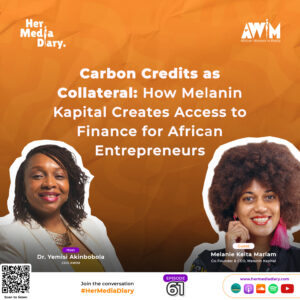
Melanie Keita is the founder and CEO of Melanin Kapital, a digital bank focused on financing Africa’s green economy. Born and raised in France, Melanie built a career in sustainable finance across Europe and Africa, working with the United Nations in Kenya and the German fund Finance in Motion. Her work spans corporate finance, sustainable development, and impact investing, with a focus on agriculture, renewable energy, electric mobility, and recycling. Today, she leads Melanin Kapital from Nairobi, providing innovative financing solutions to African SMEs through carbon credits, invoice financing, and clean technology loans.
In this episode, Melanie discusses her decision to leave Europe and build for Africa, the philosophical foundations of her work, and why the continent’s financing gap is as much a narrative problem as it is a structural one. Melanie shares how her childhood experiences with racism in rural France planted the seed for her return to the continent, and how her father’s story of forced migration for economic survival shaped her commitment to creating a future where Africans can choose where they live and work.
Also Stream: Who Owns AI-Generated Content? Legal Questions African Journalists Need to Ask
A significant portion of the conversation focuses on why African women and SMEs are systematically denied access to finance. Melanie explains how traditional banks fail to design products suited to women’s business models, how Venture Capital (VC) spaces remain male-dominated and uncomfortable for women, and why only 2.6 per cent of global venture capital goes to women-led businesses. She breaks down the different types of financing African women need, from short-term cash flow loans for traders and farmers to longer-term growth capital for manufacturers and tech entrepreneurs, and why trust, segmentation, and cultural understanding are essential to closing the gender financing gap.
Melanie also introduces listeners to the innovative financing model Melanin Capital uses, including carbon credits as collateral. She explains how African businesses in the green economy are already saving carbon through electric vehicles, renewable energy, and sustainable agriculture, and how those carbon savings can be certified and sold to polluting companies in Europe and America. She argues that Africa should not be seen as a continent of potential waiting to be unlocked, but as a market already building, already innovating, and already delivering essential services to millions of people every day. Melanie reminds listeners that migration should be a choice, not an economic necessity.
CHAPTERS:
00:00 Introduction: From France to Nairobi – Building for Africa
00:52 Growing Up Between Two Worlds: Racism and the Call to Return
04:08 Family Legacy: Congo, Senegal, and the Weight of Diaspora Expectations
07:13 The Finance Gap: Why African Entrepreneurs Can’t Access Capital
11:31 The Gender Finance Gap: 44 Billion Dollars and Counting
13:21 Why Banks Fail Women: Product Design, Trust, and Cultural Disconnect
16:57 The VC Bro Culture Problem: Trust, Bias, and Uncomfortable Questions
21:14 What is Melanin Kapital? Green Economy Financing Explained
24:07 Carbon Credits as Collateral: Turning Environmental Impact Into Capital
27:42 The Narrative Problem: Why Perception Blocks African Investment
28:35 Philosophy Meets Finance: Ubuntu, Sankofa, and Building With Soul
29:41 The Real Risk Assessment: Comparing African SMEs to Silicon Valley Failures
33:53 Marketing Africa’s Reality: From Potential to Present Tense
34:22 The Ebola Question: Confronting Investor Ignorance and Media Damage
36:38 Speaking the Language of Capital: Returns, Risk, and Unit Economics
38:59 Building the Value Chain: From SMEs to Economic Transformation
41:32 A Message to Young African Women in the Diaspora
42:17 The Choice Between Migration and Expatriation
44:31 What I Wish I’d Known: There is No Summit, Only the Journey
46:22 Closing Thoughts: The Story Problem and What Gets Built
If this episode resonated with you, subscribe, leave a review, and share it with someone who needs to hear it. Your support helps amplify conversations that strengthen media ecosystems across Africa.
Interested in joining a future episode of Her Media Diary? Email: yemisi@africanwomeninmedia.com
Join the ongoing conversation using #HerMediaDiary.
Her Media Diary is produced by African Women in Media (AWiM).
Follow African Women in Media (AWiM):
Facebook (https://www.facebook.com/share/1ARgsBptVC/)
LinkedIn (https://www.linkedin.com/company/african-women-in-media/)
TikTok (https://www.tiktok.com/@realawim?_r=1&_t=ZS-93QVDxwCcv1)
X (Twitter) (https://x.com/RealAWiM)
Instagram (https://www.instagram.com/africanwomeninmedia?igsh=MXA4NTc4NjF1NTFnbQ==)