
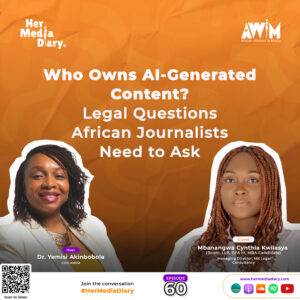
Mbanangwa Kwilasya is a compliance expert, data protection specialist, and founder of MK Legal Consultancy. She played a pivotal role in drafting Malawi’s Data Protection Act, which came into force in 2024. Her work spans financial services, fintech, anti-money laundering regulations, and AI governance. As a consultant with the African Union Development Agency, she focuses on ethical AI development, intellectual property law, and building African-centric frameworks for data protection that account for the continent’s diverse cultures, economies, and infrastructures.
In this episode, Mbanangwa shares insights on the legal dimensions of AI adoption in African newsrooms. From her childhood in Malawi, shaped by strong women, to her unwavering commitment to becoming a lawyer, Mbanangwa shares how she founded MK Legal Consultancy to bridge the gap between law, compliance, and emerging technology. She explains the painstaking process of drafting Malawi’s Data Protection Act, including consultations with neighbouring countries, the challenge of aligning new legislation with existing laws, and the frustration of watching policy-heavy systems fail at enforcement.
A significant portion of the conversation focuses on the legal questions African journalists are not asking about AI. Mbanangwa warns that newsrooms using AI tools without internal policies risk exposing confidential sources, publishing hallucinated information, and reproducing Western biases embedded in training data. She describes how uploading reports to ChatGPT can constitute a data breach, how Grok was used to generate non-consensual nude images of women, and why Nigeria’s enforcement actions against Gemini and Meta set a crucial precedent for the continent. She argues that African IP and data protection laws must be updated and unified at a continental level to prevent digital colonisation and fragmented regulatory responses.
Mbanangwa also addresses the disproportionate impact of AI on women, from deepfakes and image abuse to biased content moderation. She reflects on the UK’s decision to ban social media for children under 16. She closes with a powerful message: protecting data is protecting people. When journalists safeguard the information entrusted to them, they protect their sources, their credibility, and the future of storytelling on the continent.
CHAPTERS
00:00 Introduction: AI and African Newsrooms – The Legal Questions We Need to Ask
01:00 Meet Mbanangwa Kwilasya: From Malawi to AI Governance and Data Protection
02:11 Growing Up in Malawi: Early Memories and the Women Who Shaped Her
07:06 Always Wanting to Be a Lawyer: The Path from Childhood Dream to Compliance
10:34 Founding MK Legal Consultancy: Building a Business at the Intersection of Law and Tech
12:56 An African-Centric Approach to Data Protection: Context, Culture, and Infrastructure
14:23 Drafting Malawi’s Data Protection Act: Consultation, Adoption, and Implementation
20:34 Legal Questions African Newsrooms Should Be Asking About AI
25:43 Who Owns AI-Generated Content? The Intellectual Property Gap in Africa
29:11 The Fragmentation Problem: Why Africa Needs Continental AI Governance
32:38 Whose Responsibility Is It? Innovation, Finance, and Enforcement in Africa
36:59 Synthesised Data and African Context: Training AI on Our Own Terms
37:41 Data Protection in Daily AI Use: What Happens When You Upload to ChatGPT?
41:36 Responsible AI Use: Data Minimisation and Internal Newsroom Policies
43:21 AI’s Disproportionate Impact on Women: Surveillance, Abuse, and Bias
44:14 Image Rights and AI Violations: The Grok Case and Policy Responses
48:45 ChatGPT and Sexualized Images: The Ongoing Battle for Digital Safety
50:03 Social Media Bans for Children: A Parent’s Perspective on Protection
54:34 Closing the Gap: Unified Legislation and Continental Enforcement
58:01 Final Thoughts: Protecting Data is Protecting People
If this episode resonated with you, subscribe, leave a review, and share it with someone who needs to hear it. Your support helps amplify conversations that strengthen media ecosystems across Africa.
Interested in joining a future episode of Her Media Diary? Email: yemisi@africanwomeninmedia.com
Learn more about the book Regulating New Media in Africa, edited by Dr Yemisi Akinbobola, Dr Vincent Obia, Dr Suleiman Barr, and Professor Oliver Carter, available from Intellect Books and major academic booksellers.
Her Media Diary is produced by African Women in Media (AWiM). And this episode is sponsored by Luminate.
Follow African Women in Media (AWiM):
Facebook (https://www.facebook.com/share/1ARgsBptVC/)
LinkedIn (https://www.linkedin.com/company/african-women-in-media/)
TikTok (https://www.tiktok.com/@realawim?_r=1&_t=ZS-93QVDxwCcv1)
X (Twitter) (https://x.com/RealAWiM)
Instagram (https://www.instagram.com/africanwomeninmedia?igsh=MXA4NTc4NjF1NTFnbQ==)