
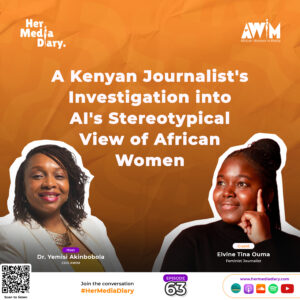
Elvine Tina Ouma is a journalist, podcaster, and curator of Kenya’s first feminist magazine. She is the host of the Feminist Spark podcast and has published across Women’s Media Centre, The Elephant, Minority Africa, African Women in Media’s AWiNews platform, The Nation, The Star, and Potentash Africa. As a recent fellow on gender and AI reporting, Elvine spent six months investigating how artificial intelligence is landing in the lives of African women, documenting stories that reveal both the promise and peril of AI adoption across Kenya’s media, health, and political landscapes.
In this episode, Dr Yemisi Akinbobola sits down with Elvine to explore her journey from a small town in Western Kenya to becoming one of the continent’s most compelling voices on AI, gender, and digital rights. Elvin shares how her father nurtured her interest in politics from a young age, asking her to name government ministers and sparking a curiosity that would later shape her journalism. She recounts writing her first story at nine, starting a blog during COVID to document untold stories of widows, orphans, and survivors, and how fiction writing remains a dream she intends to pursue alongside her investigative work. Elvine also reflects on how her first fellowship with African Women in Media, focused on reporting on women in politics, set the stage for her current work examining how AI accelerates violence against women leaders in Kenya.
Also Stream: AI Won’t Take Your Job; But Journalists Who Don’t Learn It Might Lose Theirs
A significant portion of the conversation focuses on the four groundbreaking stories Elvine produced during her fellowship. The first investigated contraception access for women with disabilities and uncovered a shocking 19-year data gap. Elvine explains how this gap undermines AI systems designed to deliver health services, as apps and chatbots are trained on data from India rather than Kenyan lived realities. She shares stories of young women with disabilities who use contraception to preserve their dignity, yet face healthcare systems and AI tools that lack the capacity to understand their needs. Her second story examined Kenya’s obsession with feminising bad governance, documenting how AI accelerated the creation and circulation of misogynistic imagery during the 2024 finance bill protests. Politicians and activists were placed in bras, heels, and wigs to signal they were weak or corrupt, with the insult being womanness itself. Elvin spoke to renowned Kenyan cartoonist Gado, who told her that AI lacks the nuance political satire requires and that what is circulating online is not satire but intentional harm.
Elvine’s third story investigated the TikTok stranger removal trend, where users developed coded language to bypass algorithmic censorship and promote unsafe abortion services. She reveals how the mass layoff of Kenyan content moderators, replaced by AI systems that do not understand Sheng or local slang, allowed quack doctors to thrive on the platform. These sellers offer half dosages of abortion medication to maximise profit, leading to a spike in post abortion complications reported at Nairobi hospitals. Her final story was an image generation experiment that revealed how AI sees Kenyans. Doctors, presidents, and governors were all men. Nannies, nurses, and TikTokers were women. When prompted to generate images of Kenyan Muslim women at the coast, AI produced Palestinian-looking women. When asked for a young Kenyan woman at Mandamano, a protest, AI generated a light-skinned woman in booty shorts and a bralette, while a Gen Z protester without gender specification was a fully dressed man holding a Kenyan flag. Elvine argues that these biases are not neutral. They reflect and reinforce stereotypes that risk erasing African women from digital spaces.
CHAPTERS:
00:00 Introduction: When AI Erases African Women
01:34 Meet Elvine Tina Ouma: Growing Up in Western Kenya
03:15 From Fiction Writing to Feminist Journalism
05:52 The Gender and AI Reporting Fellowship
10:40 Story One: The 19-Year Data Gap on Women with Disabilities
17:10 AI Healthcare Apps Trained on Indian Data
18:38 Story Two: Kenya’s Obsession with Feminising Bad Governance
21:15 When Satire Loses Nuance: A Conversation with Gado
23:11 The Harm to Female Political Candidates
24:26 Story Three: The TikTok Stranger Removal Trend
27:04 Why AI Cannot Understand Sheng and Local Language
31:52 Story Four: The Image Generation Experiment
38:09 When AI Erases Kenyan Muslim Women
39:12 The Woman at Mandamano: Sexualized and Stereotyped
42:29 Impact and Accountability: What Happened After the Stories
46:37 The Risk of AI Erasure for African Women
51:03 Data Centres, Water, and the Environmental Cost of AI
53:18 Will Africa Pay the Price for AI Adoption?
54:38 Closing Reflections: AI is Probability Math, Not Intelligence
If this episode resonated with you, subscribe, leave a review, and share it with someone who needs to hear it. Your support helps amplify conversations that strengthen media ecosystems across Africa.
Interested in joining a future episode of Her Media Diary? Email: yemisi@africanwomeninmedia.com
Join the ongoing conversation using #HerMediaDiary.
Her Media Diary is produced by African Women in Media (AWiM). This episode is sponsored by Luminate.
Follow African Women in Media (AWiM):
Facebook (https://www.facebook.com/share/1ARgsBptVC/)
LinkedIn (https://www.linkedin.com/company/african-women-in-media/)
TikTok (https://www.tiktok.com/@realawim?_r=1&_t=ZS-93QVDxwCcv1)
X (Twitter) (https://x.com/RealAWiM)
Instagram (https://www.instagram.com/africanwomeninmedia?igsh=MXA4NTc4NjF1NTFnbQ==)