
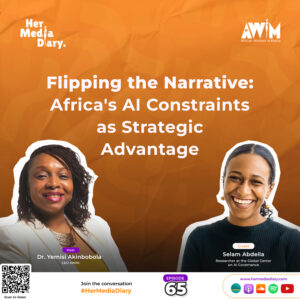
Selam Abdella is a researcher at the Global Center on AI Governance and co-author of research exploring what it would take to flip the narrative on AI in the Global South. She argues that the constraints African countries face are not just obstacles, but potential strategic advantages. Selam has spoken at UN Women and the Sexual Violence Research Initiative’s policy dialogue series on generative AI and tech facilitated gender based violence, making the case that mitigating the harms of AI is not merely a technical challenge but a question of power.
She is also leading the development of a massive open online training course aimed at advancing African perspectives on inclusive and context-responsive AI. In this episode, Dr Yemisi Akinbobola sits down with Selam to explore the gap between government commitment and lived reality, between what African governments say they are doing about AI and what is actually happening to women on the receiving end. Selam shares how she left Ethiopia at 16 to attend boarding school in Toronto, and how her curiosity across disciplines, from art to law to development, eventually led her to AI governance. She reflects on how growing up in a city that is both a hub for development and deeply reliant on agriculture shaped her understanding of the contradictions and possibilities of technology on the continent.
A significant portion of the conversation focuses on the findings of the Global Index on Responsible AI, which Selam co-authored with Dr Rachel Adams and colleagues. The index reveals that 126 of 135 countries have at least one government AI policy or initiative, yet this does not often translate into meaningful protection. Selam explains that while responsible AI language is appearing in governance frameworks across Africa, enforceable protection mechanisms for harms such as tech facilitated gender based violence or the circulation of AI-generated intimate imagery remain absent.
She describes how women seeking political office are targeted with false information and manipulated images, creating a chilling effect that discourages women from participating in digital campaigns or seeking elected positions. Selam also discusses the Sexual Violence Research Initiative’s community of practice, which is working to define tech facilitated gender based violence and introduce it into legislative spaces across the continent. Selam introduces the concept of flipping the narrative on AI constraints in Africa, arguing that what are often framed as disadvantages can become strategic advantages if addressed deliberately. She explains frugal AI, a concept that emphasises using resources mindfully to create smaller, more precise, and context-specific systems rather than chasing the biggest and most resource-intensive models.
She connects this to the environmental impact of AI, reminding listeners that water scarcity, climate change, and agriculture are gendered issues on the continent, and that the push for data centres must be weighed against environmental and monetary sustainability. Selam questions whether every African country needs its own data centre or whether regional cloud infrastructures with strong data transfer policies might be more viable and responsible solutions. Selam also addresses what it means for African women journalists who are doubly exposed to tech facilitated gender based violence because they are front-facing storytellers expected to use AI tools in their work.
She urges newsrooms to ask whether the AI tools they introduce have safety by design, to champion regulations that protect marginalised communities, and to establish institutional redress and accountability mechanisms even while waiting for government policies to catch up. She closes with a powerful message to journalists: transparency is not only a requirement for those being regulated, but for governments themselves. African governments have started regulating AI, but they have yet to disclose their own use of it, and that lack of transparency limits honest conversations about how AI is impacting lives and livelihoods across the continent.
CHAPTERS:
00:00 Introduction: The Gap Between AI Commitment and Reality for Women
02:15 Growing Up in Addis: An Urban African Woman’s Journey
03:49 From Addis to Toronto: The Boarding School Leap at 16
05:36 The Global Index on Responsible AI: Key Findings for Africa
07:47 When Policy Doesn’t Protect: The Gender and AI Gap in Practice
10:52 Defining Tech-Facilitated Gender-Based Violence: The First Step
12:37 Constraints to Capability: Flipping the Narrative on AI in the Global South
15:29 Frugal AI and Environmental Justice: Water, Women, and Data Centres
20:16 Learning the Technical: A Social Scientist’s Journey into AI Infrastructure
21:36 Training for African Perspectives: MOOCs and Media Literacy
26:12 Double Exposure: African Women Journalists and Tech-Facilitated Violence
26:55 What Newsrooms Must Do: Safety by Design and Advocacy for Protection
29:15 The 93 Per cent Problem: Why Policies Aren’t Translating to Protection
32:52 The Personal Cost: Working on Urgent Challenges Without Easy Answers
35:23 Inspiration and Alternative Thinking: From Mindy Seu to Timnit Gebru
37:11 The Transparency Gap: What African Newsrooms Need to Know
38:45 Closing Reflections: Whose Voices Were in the Room
If this episode resonated with you, subscribe, leave a review, and share it with someone who needs to hear it. Your support helps amplify conversations that strengthen media ecosystems across Africa. Interested in joining a future episode of Her Media Diary? Email: yemisi@africanwomeninmedia.com
Join the ongoing conversation using #HerMediaDiary. Her Media Diary is produced by African Women in Media (AWiM),
Follow African Women in Media (AWiM):
Facebook (https://www.facebook.com/share/1ARgsBptVC/)
LinkedIn (https://www.linkedin.com/company/african-women-in-media/)
TikTok (https://www.tiktok.com/@realawim?_r=1&_t=ZS-93QVDxwCcv1)
X (Twitter) (https://x.com/RealAWiM)
Instagram (https://www.instagram.com/africanwomeninmedia?igsh=MXA4NTc4NjF1NTFnbQ==)