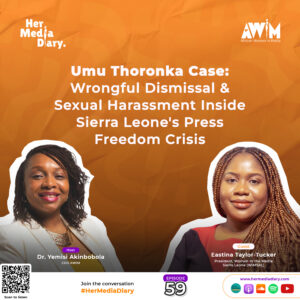
Eastina Taylor-Tucker is the president of Women in News Media Sierra Leone (WIMSAL), a seasoned broadcaster and advocate who has worked with BBC Media Action and stands at the centre of one of West Africa’s most significant press freedom cases in recent years. A 2018 Mandela Washington Fellow, Eastina has spent her career challenging structural inequalities in newsrooms and fighting for the safety and dignity of women journalists across Sierra Leone.
In this episode, Dr Yemisi Akinbobola interviews Eastina to explore her journey to becoming a leading voice for gender justice in media. She shares how she entered journalism at 19, aced an interview despite being told she was too young and too small, and went on to work across Christian radio, mainstream media, community radio mentorship with BBC Media Action, and eventually as station manager of one of Sierra Leone’s largest commercial stations.
A significant portion of the conversation focuses on the case of Umu Thoronka, a WIMSAL member and journalist who faced wrongful termination from Sierra Leone Broadcasting Corporation. Eastina walks listeners through the years-long advocacy effort led by WIMSAL, including engagement with the Robert F. Kennedy Center for Human Rights, the Independent Media Commission, and ultimately an ECOWAS court process. She explains how Umu was dismissed via phone call without warning after covering a presidential press conference and posting about being denied the opportunity to ask questions. The backlash Umu faced included death threats, online abuse, and physical intimidation, all for exercising her right to free expression.
Also Stream: Beyond SEO: Why Answer Engine Optimization is the Future of Digital Visibility
Eastina also opens up about her own experience of sexual assault by a colleague, an incident she kept silent about for years due to fear, shame, and the knowledge that speaking out often leads to disbelief and isolation.
Eastina closes with a powerful call to action for policymakers, media owners, and editors. She urges them to stop treating gender-based violence as a misunderstanding or private issue and to recognize it as a serious workplace and human rights crisis. She envisions a media landscape where women are respected as professionals first, where harassment complaints are handled confidentially and independently, and where leadership undergoes mandatory gender sensitivity training. Protecting women journalists, she argues, is not just about protecting women. It is about protecting the credibility and future of journalism itself.
CHAPTERS
00:00 Introduction: Building a Career in Sierra Leone’s Media Landscape
01:30 Growing Up in Freetown: Early Signs of a Communicator
05:50 From School Plays to Radio: Breaking Into Media at 19
09:41 Facing Inequality in Mainstream Media: The AYV Experience
10:38 Mentoring Community Journalists: Six Years with BBC Media Action
11:39 On Our Radar and Capital Radio: Leading a Major Media House
17:59 The Umu Thoronka Case: Wrongful Dismissal and Sexual Harassment
20:45 Death Threats, Intimidation, and a Phone Call Dismissal
24:54 Fighting for Justice: From IMC to ECOWAS Court
27:01 The Epidemic of Silence: Sexual Harassment Across Sierra Leone’s Newsrooms
29:48 The Kigali Declaration: What It Takes to Operationalize Gender Safety
34:45 Eastina’s Story: Sexual Assault and the Price of Speaking Out
42:08 Men Who Believed: Finding Support in Unexpected Places
43:27 Advice to Her Younger Self: Trust Your Voice and Protect Your Mental Health
44:50 What Genuinely Safe Newsrooms Look Like: A Call to Action
47:39 Closing: Protecting Women Journalists is Protecting Press Freedom
If this episode resonated with you, subscribe, leave a review, and share it with someone who needs to hear it. Your support helps amplify conversations that strengthen media ecosystems across Africa.
If Umu Thoronka’s story moved you, follow the case by searching her name online. If you are a woman in a newsroom who recognizes these experiences, reach out to organizations like WIMSAL or your local media associations. You are not alone, and you are not wrong for wanting better.
Interested in joining a future episode of Her Media Diary? Email yemisi@africanwomeninmedia.com
Her Media Diary is produced by African Women in Media (AWiM).
Follow African Women in Media (AWiM):
Facebook | LinkedIn | TikTok | X (Twitter) | Instagram